
diff options
Diffstat (limited to '_posts')
| -rw-r--r-- | _posts/2020-10-24-tiny-linux-c-binaries.md | 387 |
1 files changed, 0 insertions, 387 deletions
diff --git a/_posts/2020-10-24-tiny-linux-c-binaries.md b/_posts/2020-10-24-tiny-linux-c-binaries.md deleted file mode 100644 index 1fec202..0000000 --- a/_posts/2020-10-24-tiny-linux-c-binaries.md +++ /dev/null @@ -1,387 +0,0 @@ ---- -layout: post -title: Tiny C Binaries -author: Dylan Müller ---- - -> By default, following the linking stage, `GCC` generates `ELF` binaries that contain -> redundant section data that increase executable size. - -1. [ELF Binaries](#elf-binaries) -2. [Size Optimisation](#size-optimisation) -3. [Linux Syscalls](#linux-syscalls) -4. [Custom Linker Script](#custom-linker-script) -5. [GCC flags](#gcc-flags) -6. [SSTRIP](#sstrip) -7. [Source Code](#source-code) - -# ELF Binaries - -The standard file format for executable object code on Linux is `ELF` (Executable -and Linkable Format), it is the successor to the older `COFF` `UNIX` file format. - -`ELF` Binaries consist of two sections, the `ELF` header and file data (object -code). The `ELF` header format for `64-bit` binaries is shown in the table below: - -| Offset | Field | Description | Value | -|--------|------------------------|----------------------------------------|---------------------------------------------------------------------------------------| -| 0x00 | e_ident[EI_MAG0] | magic number | 0x7F | -| 0x04 | e_ident[EI_CLASS] | 32/64-bit | 0x2 = 64-bit | -| 0x05 | e_ident[EI_DATA] | endianness | 0x1 = little<br>0x2 = big | -| 0x06 | e_ident[EI_VERSION] | elf version | 0x1 = original | -| 0x07 | e_ident[EI_OSABI] | system ABI | 0x00 = System V<br>0x02 = NetBSD<br>0x03 = Linux<br>0x09 = FreeBSD<br> | -| 0x08 | e_ident[EI_ABIVERSION] | ABI Version | * ignored for static-linked binaries<br>* vendor specific for dynamic-linked binaries | -| 0x09 | e_ident[EI_PAD] | undefined | * padded with zeros | -| 0x10 | e_type | object type | 0x00 = ET_NONE<br>0x01 = ET_REL<br>0x02 = ET_EXEC<br>0x03 = ET_DYN<br>0x04 = ET_CORE | -| 0x12 | e_machine | system ISA | 0x3E = amd64<br>0xB7 = ARM (v8/64) | -| 0x14 | e_version | elf version | 0x1 = original | -| 0x18 | e_entry | entry point | 64-bit entry point address | -| 0x20 | e_phoff | header table offset | 64-bit program header table offset | -| 0x28 | e_shoff | section table offset | 64-bit section header table offset | -| 0x30 | e_flags | undefined | vendor specific or pad with zeros | -| 0x34 | e_ehsize | elf header size | 0x40 = 64bits, 0x20 = 32bits | -| 0x36 | e_phentsize | header table size | - | -| 0x38 | e_phnum | #(num) entries in header table | - | -| 0x3A | e_shentsize | section table size | - | -| 0x3C | e_shnum | #(num) entries in section table | - | -| 0x3E | e_shstrndx | section names index into section table | - | -| 0x40 | | | End of 64-bit ELF | - -These data fields are used by the Linux `PL` (program loader) to resolve the entry -point for code execution along with various fields such as the `ABI` version, `ISA` -type, as well as section listings. - -A sample hello world program is shown below and was compiled with `GCC` using `gcc -main.c -o example`. - -``` -#include <stdio.h> - -int main(int agrc, char *argv[]){ - printf("Hello, World!"); - return 0; -} -``` - -This produced an output executable of almost **~17 KB** ! If you've ever -programmed in assembly you might be surprised at the rather large file size for -such a simple program. - -`GNU-binutils` `objdump` allows us to inspect the full list of `ELF` sections with -the `-h` flag. - -After running `objdump -h example` on our sample binary we see that there are a -large number of `GCC` derived sections: `.gnu.version` and `.note.gnu.property` -attached to the binary image. The question becomes how much data these -additional sections are consuming and to what degree can we 'strip' out -redundant data. - -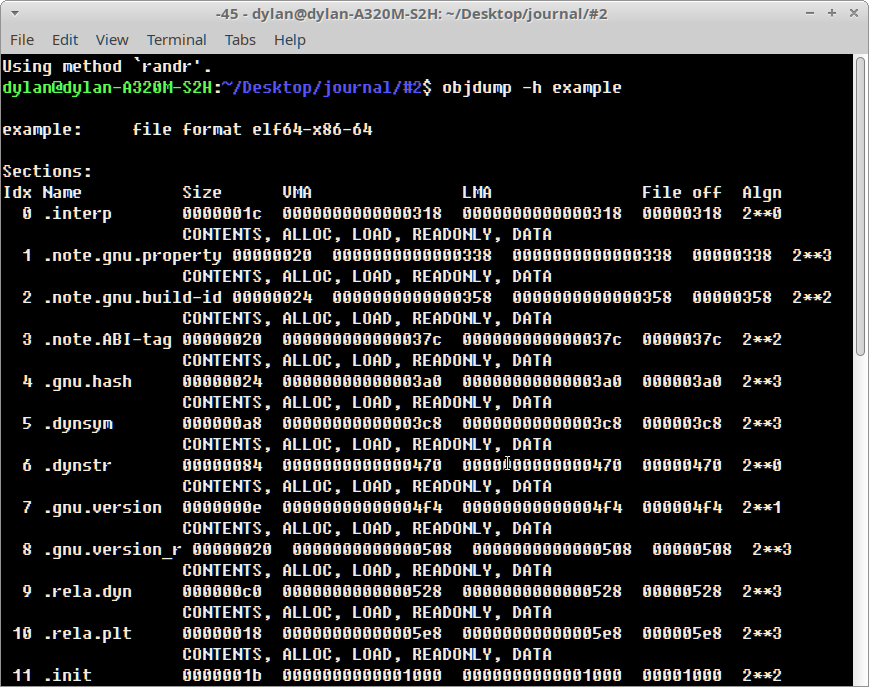 - -`GNU-binutils` comes with a handy utility called `strip`, which attempts to remove -unused `ELF` sections from a binary. Running `strip -s example` results only in a -slightly reduced file of around **~14.5 KB**. Clearly, we need to strip much -more! :open_mouth: - -# Size Optimisation - -`GCC` contains a large number of optimisation flags, these include the common : -`-O2 -O3 -Os` flags as well as many more less widely used compile time options, -which we will explore further. However, since we have not yet compiled with any -optimisation thus far, and as a first step we recompile the above example with -`-Os`, to optimise for size. - - - -And we see no decrease in size! This is expected behaviour however, since the -`-Os` flag does not consider all redundant section data for removal, on the -contrary the additional section information placed by `GCC` in the output binary -is considered useful at this level of optimisation. - -In addition, the use of `printf` binds object code from the standard library -into the final output executable and so we will instead call through to the -Linux kernel directly to print to the standard output stream. - -# Linux syscalls - -System calls on Linux are invoked with the `x86_64` `syscall` opcode and syscall -parameters follow a very specific order on `64-bit` architectures. For `x86_64` -([System V ABI - Section -A.2.1](https://refspecs.linuxfoundation.org/elf/x86_64-abi-0.99.pdf)), the order -of parameters for linux system calls is as follows: - -| description | register (64-bit) | -|----------------|----------| -| syscall number | rax | -| arg 1 | rdi | -| arg 2 | rsi | -| arg 3 | rdx | -| arg 4 | r10 | -| arg 5 | r8 | -| arg 6 | r9 | - - -Arguments at user mode level (`__cdecl` calling convention), however, are parsed in -the following order: - -| description | register (64-bit) | -|-------------|-----| -| arg 1 | rdi | -| arg 2 | rsi | -| arg 3 | rdx | -| arg 4 | rcx | -| arg 5 | r8 | -| arg 6 | r9 | - -To call through to the linux kernel from `C`, an assembly wrapper was required to -translate user mode arguments (`C` formal parameters) into kernel `syscall` -arguments: - -``` -syscall: - mov rax,rdi - mov rdi,rsi - mov rsi,rdx - mov rdx,rcx - mov r10,r8 - mov r8,r9 - syscall - ret -``` - -We may then make a call to this assembly routine from `C` using the following -function signature: - -``` -void* syscall( - void* syscall_number, - void* param1, - void* param2, - void* param3, - void* param4, - void* param5 -); -``` - -To write to the standard output stream we invoke syscall `0x1`, which handles -file output. A useful `x86_64` Linux syscall table can be found -[here](https://blog.rchapman.org/posts/Linux_System_Call_Table_for_x86_64/). -Syscall `0x1` takes three arguments and has the following signature: - -`sys_write( unsigned int fd, const char *buf, size_t count)` - -A file called `base.c` was created, implementing both `syscall` and print wrappers: - -``` -// base.c -typedef unsigned long int uintptr; -typedef long int intptr; - -void* syscall( - void* syscall_number, - void* param1, - void* param2, - void* param3, - void* param4, - void* param5 -); - -static intptr print(void const* data, uintptr nbytes) -{ - return (intptr) - syscall( - (void*)1, /* sys_write */ - (void*)(intptr)1, /* STD_OUT */ - (void*)data, - (void*)nbytes, - 0, - 0 - ); -} - -int main(int agrc, char *argv[]){ - print("Hello, World", 12) - return 0; -} -``` - -In order to instruct `GCC` to prevent linking in standard library object code, the -`-nostdlib` flag should be passed at compile time. There is one caveat however, -in that certain symbols, such as `_start` , which handle program startup and the -parsing of the command line arguments to `main` , will be left up to us to -implement, otherwise we will segfault :-/ - -However, this is quite trivial and luckily program initialisation is well -defined by -- [System V ABI - Section -3.4](https://refspecs.linuxfoundation.org/elf/x86_64-abi-0.99.pdf). - -Initially it is specified that register `rsp` hold the argument count, while the -address given by `rsp+0x8` hold an array of `64-bit` pointers to the argument -strings. - -From here the argument count and string pointer array index can be passed to -`rdi` and `rsi` respectively, the first two parameters of `main()` . Upon exit, -a call to syscall `0x3c` is then made to handle program termination gracefully. - -Both the syscall and program startup assembly wrappers (written in GAS) were -placed in a file called `boot.s`: - -``` -/* boot.s */ -.intel_syntax noprefix -.text -.globl _start, syscall - -_start: - xor rbp,rbp /* rbp = 0 */ - pop rdi /* rdi = argc, rsp= rsp + 8 */ - mov rsi,rsp /* rsi = char *ptr[] */ - and rsp,-16 /* align rsp to 16 bytes */ - call main - mov rdi,rax /* rax = main return value */ - mov rax,60 /* syscall= 0x3c (exit) */ - syscall - ret - -syscall: - mov rax,rdi - mov rdi,rsi - mov rsi,rdx - mov rdx,rcx - mov r10,r8 - mov r8,r9 - syscall - ret -``` - -Finally gcc was invoked with `gcc base.c boot.s -nostdlib -o base`. - -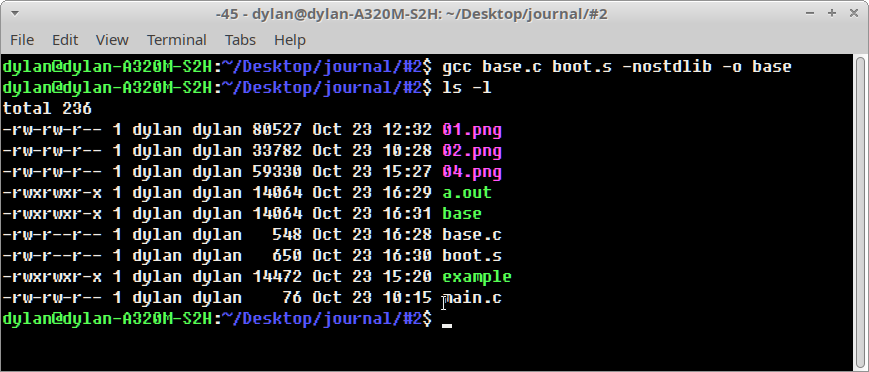 - -Wait what!? We still get a **~14 KB** executable after all that work? Yep, and -although we have optimised the main object code for our example, we have not yet -stripped out redundant `ELF` code sections which contribute a majority of the file -size. - -# Custom Linker Script - -Although it is possible to strip some redundant sections from an `ELF` binary -using `strip`, it is much more efficient to use a custom linker script. - -A linker script specifies precisely which `ELF` sections to include in the output -binary, which means we can eliminate *almost* all redundancy. Care, however, -must be taken to ensure that essential segments such as `.text`, `.data`, -`.rodata*` are not discarded during linking to avoid a segmentation fault. - -The linker script that I came up with is shown below (`x86_64.ld`): - -``` -OUTPUT_FORMAT("elf64-x86-64", "elf64-x86-64", - "elf64-x86-64") -OUTPUT_ARCH(i386:x86-64) -ENTRY(_start) - -SECTIONS -{ - . = 0x400000 + SIZEOF_HEADERS; - .text : { *(.text) *(.data*) *(.rodata*) *(.bss*) } -} -``` - -The linker script sets the virtual base address of the output binary to `0x400000` -and retains only the essential code segments. - -Custom linker scripts are parsed to `GCC` with the `-T` switch and the resulting -binary was compiled with: `gcc -T x86_64.ld base.c boot.s -nostdlib -o base`. - -This produced an output executable of around **~2.7 KB**. - -This is much better, but there is still some room for improvement using -additional `GCC` compile time switches. - -# GCC Flags - -We have thus far managed to shrink our executable size down to **~2.7 KB** from our -initial file size of **~17 KB** by stripping redundant section data using a custom -linker script and removing standard library object code. - -However, `GCC` has several compile time flags that can further help in removing -unwanted code sections, these include: - -| flag | description | -|----------------------|---------------------------------------| -| -ffunction-sections | place each function into own section | -| -fdata-sections | place each data item into own section | -| -Wl,\--gc-sections | strip unused sections (linker) | -| -fno-unwind-tables | remove unwind tables | -| -Wl,\--build-id=none | remove build-id section | -| -Qn | remove .ident directives | -| -Os | optimize code for size | -| -s | strip all sections | - -Compiling our example again with: `gcc -T x86_64.ld base.c boot.s -nostdlib -o -base -ffunction-sections -fdata-sections -Wl,--gc-sections -fno-unwind-tables --Wl,--build-id=none -Qn -Os -s`. - -This produces an output executable with a size of **~1.5 KB** but we can still go -further! - -Additionally, you can include the `-static` switch to ensure a static binary. -This results in an output executable of **~640 bytes**. - -# SSTRIP - -Despite all our optimisation thus far, there are still a few redundant code and -data sections in our dynamically linked output executable. Enter `sstrip`... - -[sstrip](https://github.com/aunali1/super-strip) is a useful utility that -attempts to identify which sections of an `ELF` binary are to be loaded into -memory during program execution. Based off this, all unused code and data -sections are then subsequently removed. It is comparable to `strip` but performs -section removal more aggressively. - -Running `./sstrip base` we get our final executable binary with a size of **~830 -bytes** ! - -At this point it would probably be best to switch to assembly to get smaller -file sizes, however the goal of this `journal` was to create small executables -written in `C` and I think we've done quite well to reduce in size from **~17 KB** -down to **~830 bytes**! - -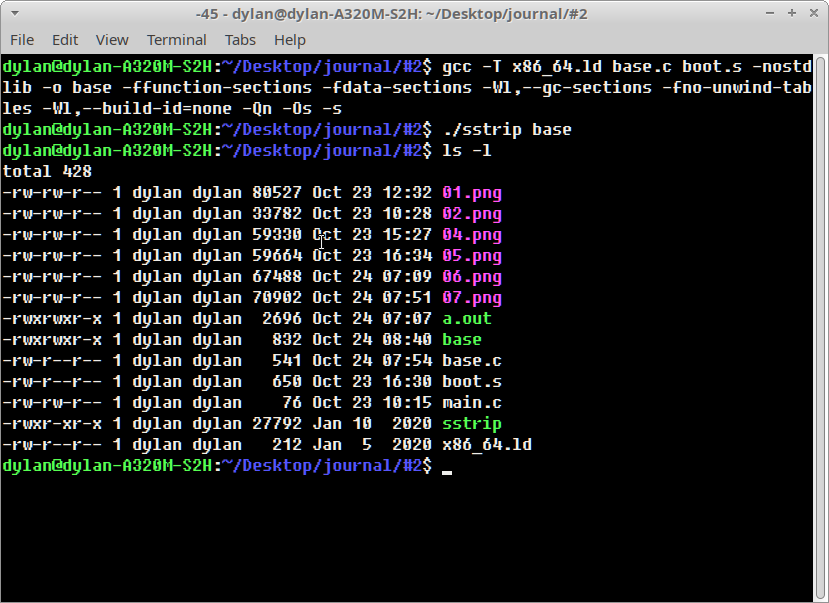 - -As a final comment you might be wondering if we could have simply run `sstrip` -from our **17 KB** executable in the first place and the answer would be, no. - -I tried doing this and ended up with a binary image of around **~12 KB** so it seems -the sstrip needs a bit of additional assistance in the form our our manual -optimisations to get really `tiny` binaries! - -# Source Code - -Source code used in this `journal` is available at: -[https://github.com/lunar-rf/tinybase](https://github.com/lunar-rf/tinybase) - -# Signature - -``` -+---------------------------------------+ -| .-. .-. .-. | -| / \ / \ / \ + | -| \ / \ / \ / | -| "_" "_" "_" | -| | -| _ _ _ _ _ _ ___ ___ _ _ | -| | | | | | | \| | /_\ | _ \ / __| || | | -| | |_| |_| | .` |/ _ \| /_\__ \ __ | | -| |____\___/|_|\_/_/ \_\_|_(_)___/_||_| | -| | -| | -| Lunar RF Labs | -| https://lunar.sh | -| | -| Research Laboratories | -| Copyright (C) 2022-2024 | -| | -+---------------------------------------+ -``` |